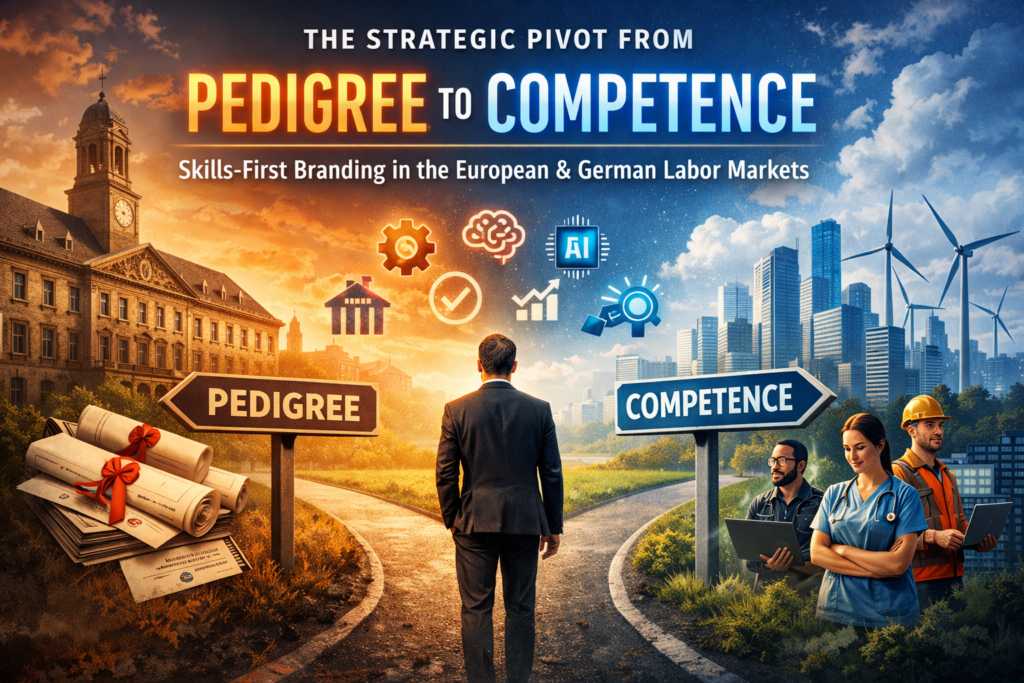
The structural foundations of the European labor market are currently experiencing a paradigmatic shift, moving away from the historical reliance on institutional pedigree toward a granular, “skills-first” methodology of talent evaluation and professional branding. This transformation is not merely a localized trend but a systemic response to a convergence of factors: acute demographic decline in core markets like Germany, the rapid obsolescence of traditional knowledge due to generative artificial intelligence, and a growing legislative emphasis on skill portability across the European Union. For a career consultant brand operating within this timeframe, the ability to navigate the tension between “credentialism”—the deep-seated instinct to hire based on university names and former employer logos—and “competence-based” matching is the primary determinant of strategic success.
The Conceptual Architecture of Skills-First Branding
The transition toward a skills-first approach represents a fundamental re-evaluation of human capital. Traditional hiring methodologies have historically asked candidates, “Where did you come from?” prioritizing the prestige of their education and the familiarity of their career path. In contrast, the skills-first ethos asks, “Where can you take us next?” focusing on demonstrable capabilities regardless of their origin. As of 2024, LinkedIn data indicates that a focus on skills can expand talent pools by a factor of ten, a necessity in a European landscape where 75% of companies report increasing difficulty in finding workers with the necessary competencies.
However, the implementation of this approach in the German and European markets between 2024 and 2026 reveals a significant disconnect between corporate rhetoric and recruiter reality. While many organizations have removed degree requirements from job descriptions—a 36% jump in such listings was observed globally between 2019 and 2022—the underlying instinct for pedigree persists. In many instances, skills-based hiring has become a “bolt-on” rather than a total redesign of the talent pipeline. Hiring managers often still sort candidates into tiers based on school lists and referrals, only applying skills assessments to those who have already cleared the pedigree gates. This creates a “finishing school” effect for pedigree, where the same people are shortlisted, but are now required to jump through additional evaluative hoops.
Comparative Framework: Pedigree vs. Skills-First Methodologies
The following table contrasts the operational metrics and philosophical underpinnings of these two competing paradigms as they manifest in the 2024–2026 labor market.
| Dimension | Pedigree-Based Branding (Legacy) | Skills-First Branding (Emergent) |
| Core Metric | Institution name, tenure, and job titles. | Proven competencies, work samples, and potential. |
| Talent Sourcing | High-tier universities and competitor networks. | “STARs” (Skilled Through Alternative Routes) and career changers. |
| Selection Logic | Credentialism as a proxy for intelligence and culture fit. | Capability verification through task-based interviews. |
| Market Resilience | Vulnerable to rapid technological shifts. | Highly adaptable; emphasizes modular, lifelong learning. |
| Diversity Impact | Can inadvertently exclude marginalized groups. | Actively widens pools to include non-traditional candidates. |
The resilience of the pedigree model in Germany is particularly noteworthy. Despite the logical clarity of skills-based hiring, German employer branding often remains rooted in the “security” of formal certifications. A career consultant brand must therefore navigate a hybrid reality where the ability to “signal” skills effectively is becoming the primary competitive advantage, even if the formal credential remains a secondary “nice to have” requirement.
Macroeconomic Context and the Demographic Storm in Germany
Germany enters 2026 at a historic economic and demographic crossroads. The “deceptive calm” of 2024 and 2025 has given way to a structural “time bomb”. By the beginning of 2026, the German labor market began to show a historic turning point: for the first time, the potential labor force started to decline in absolute terms, with a projected loss of 35,000 to 40,000 people annually. This demographic contraction occurs against a backdrop of stagnant economic growth, with Germany’s GDP projected to grow by only 0.4% in 2025 and 1.2% in 2026.
The Labor Shortage Paradox
Despite a “cooling” hiring market and an unemployment rate hovering between 5.8% and 6.3%, the shortage of qualified workers remains critical. By 2026, over 163 occupations in Germany face severe qualified worker shortages, particularly in healthcare, IT, and the skilled trades
| Sector | Shortage Intensity (2025-2026) | Primary Driver |
| IT & Software Engineering | 137,000+ unfilled roles. | Rapid digitalization and limited domestic STEM graduates. |
| Healthcare & Care | 160,000+ vacancies. | Aging population and “fastest-aging” demographic in Europe. |
| Skilled Trades (Electricians/HVAC) | 55,000+ unfilled roles. | “Energiewende” (Energy transition) and EV infrastructure. |
| Construction & Infrastructure | 220,000+ vacancies. | €110 billion infrastructure boom and climate adaptation. |
This structural gap creates a “seller’s market” for those who can prove their skills, yet many employers remain paralyzed by legacy hiring processes. For a career consultant, the strategic opportunity lies in bridging this “Skills Gap”—the number of jobs that cannot be filled with suitably qualified unemployed individuals. Even as the number of qualified unemployed persons slightly surpassed vacancies in early 2025, the match between existing skills and market needs remains fractured.
Technological Transformation and the AI Wage Premium
The rapid adoption of generative AI between 2023 and 2026 has fundamentally altered the ROI (Return on Investment) of traditional education versus modular skill acquisition. Across advanced economies, the value of specific AI-related skills has risen sharply, often outperforming the monetary returns of advanced academic degrees.
The Shift in Economic Returns
Data from 2025 indicates that the “immediate labor market returns” for targeted skill acquisition in high-demand domains like AI are becoming more attractive than traditional postgraduate education. This indicates that employers are increasingly willing to pay a premium for “proven capability from day one” rather than the “potential” signaled by a degree.
| Qualification / Skill | Advertised Salary Premium (2025 Study) |
| AI-Related Skills | +23%. |
| Master’s Degree | +13%. |
| Bachelor’s Degree | +8%. |
This data suggests a “market bifurcation” where technological proficiency acts as a primary wealth driver, while traditional degrees act as secondary stabilizers. Furthermore, the impact of AI is not uniform; while it enhances productivity for high-skilled workers, it poses significant displacement risks for routine “middle-skill” roles, such as administrative staff or graphic designers. By 2026, job advertisements mentioning AI skills have increased significantly, even as general white-collar hiring slowed, signaling that AI literacy is no longer a future-looking trait but a “baseline skill” for the modern workforce.
The Rise of “Hybrid Intelligence”
As AI adoption progresses, the most secure and high-value roles are those requiring “hybrid intelligence”—a combination of technical AI literacy and human-centric soft skills. Career consultants must brand their clients not as “replacement-ready” but as “augmentation-ready”.
| “AI-Proof” Human Skill | Mechanism of Resilience |
| Emotional Intelligence (EQ) | Understanding, motivating, and empathizing with diverse teams; critical for leadership and care. |
| Creative Problem-Solving | Navigating unpredictable environments and making ethical/legal judgments. |
| Strategic Oversight | Designing and managing agentic workflows; acting as the “human-in-the-loop” for AI innovation. |
| Interpersonal Collaboration | Relationship-building and conflict resolution in cross-functional, multi-generational teams. |
By 2030, it is projected that 70% of new job roles in Europe will be directly enabled by AI, requiring a constant cycle of upskilling and reskilling. For career consultant brands, the narrative must shift from “securing a job” to “securing a learning path”.
Legislative Enablers: Legalizing the Skills-First Movement in Germany
A critical requirement for a skills-first approach to take hold in a tradition-bound market like Germany is the creation of a formal legal and certification infrastructure. The years 2024 and 2025 have seen the implementation of landmark regulations that provide a standardized framework for validating non-formal learning.
The Vocational Training Validation and Digitization Act (BVaDiG)
The BVaDiG, which came into full force on January 1, 2025, represents a historic turning point for the German “Mittelstand” and its reliance on the dual vocational training system. For the first time, individuals over the age of 25 who have relevant professional experience but lack a formal degree are entitled to have their skills assessed and certified by competent bodies such as the IHK (Chamber of Industry and Commerce).
This validation procedure is designed to “legitimize” the career changers (Quereinsteiger) who have traditionally been disadvantaged by Germany’s rigid certification requirements. If the assessment is successful, a certificate of “full comparability” is issued, which opens doors to further training and master craftsman (Meister) qualifications. This provides employers with a “transparent assessment” of the skills of long-serving employees, allowing for better internal mobility and deployment.
The EU Skills Portability Initiative (SPI)
At the European level, the 2026 Commission Work Programme includes the flagship Skills Portability Initiative (SPI). This initiative aims to tackle the long-standing barriers to workforce mobility within the Single Market by standardizing how skills and digital credentials are recognized across borders.
The SPI is structured around three core actions:
- Digitalization and Transparency: A legislative proposal to facilitate mobility through improved digital credential infrastructure.
- Modernization for Regulated Professions: Updating the Professional Qualifications Directive (2005/36/EC) to streamline recognition in essential sectors like healthcare.
- Third-Country National Integration: Common rules to simplify the recognition of qualifications for non-EU workers, a critical necessity for meeting Germany’s need for 600,000 net migrants per year.
These legislative shifts provide the “proof points” that a career consultant brand can use to market their services to international professionals moving into the German market.
The Branding Strategy for the Modern Career Consultant
For a career consultant brand, the shift to “Skills-First” requires a dual-track branding strategy: first, establishing their own authority as a “futurist” and “trusted advisor”; and second, equipping their clients with “proof-of-work” portfolios that transcend the traditional resume.
Defining the Consultant’s Brand Persona
Success in the 2024–2026 period depends on moving away from “generic” advice toward a “niche-focused, digital-first” presence.
| Brand Type | Core Value Proposition | German Market Example |
| The Pragmatic Strategist | Clear, actionable career change strategies tailored to the German market; focus on executive consulting. | Dr. Bernd Slaghuis: Recognized for structured methodologies and deep local expertise. |
| The Digital Networker | Personal branding and social media coaching; expertise in digital networking and “contemporary” career growth. | Ute Blindert: Author and thought leader focusing on digital natives and freelancers. |
| The Accountability Coach | Frameworks for measurable career acceleration; high-touch executive leadership development. | Don Markland: Focuses on accountability systems for mid-to-senior professionals. |
| The Empowerment Specialist | Communication, presentation training, and women’s leadership; focus on building confidence. | Sabine Asgodom: Household name in Germany for motivational and practical coaching. |
Consultants who thrive in this environment are those who act as “thinking partners” for senior leaders facing the “new challenge of humanizing technology adoption”.
The Implementation of “Proof-of-Work” Portfolios
A primary service for the skills-first consultant is the transformation of a client’s “Bio” into a “Portfolio”. In a market where degree lines are vanishing but instincts remain, “measurability” is the only antidote to pedigree bias.
| Role Family | Proof-of-Work Metric | Strategic Headline Example |
| Administration | Efficiency gains, MIS management, office scale. | “Experienced Office Administrator |
| Sales | Revenue growth, partnership acquisition, CRM mastery. | “B2B Sales Manager |
| IT & Data | Code repositories, project completion, tech stack mastery. | “DevOps Engineer |
| Marketing | Lead generation, brand visibility, automation usage. | “Digital Marketing Specialist |
By 2026, the use of portfolios is no longer exclusive to the “creative” class. According to survey data, 76% of developers in Germany cite a “dope portfolio” as the key to scoring roles, and this trend is rapidly expanding into non-tech management and operational roles.
Business Model Innovation: The Bifurcated Coaching Market
As the coaching industry matures, a clear division is emerging in how services are delivered and priced. For a career consultant brand, the choice of business model determines both its market position and its long-term scalability.
High-Ticket vs. Low-Ticket Paradigms
| Feature | High-Ticket Transformational Coaching | Low-Ticket Scalable Membership |
| Price Point | $2,000 – $50,000+. | $7 – $197 / month. |
| Delivery Model | Bespoke 1-on-1, executive retreats, high-touch. | Automated funnels, digital courses, group sessions. |
| Target Audience | Senior leaders, high-net-worth career changers. | Young professionals, digital natives, career-entry STARs. |
| Sales Cycle | Weeks to months; requires deep relationship building. | Minutes to days; optimized for friction-less conversion. |
| Profit Margin | High (70-85% for solo practitioners). | High potential for volume, lower individual margin. |
The most successful brands in 2026 are adopting “Hybrid Models,” blending high-ticket individual consulting with “productized” services, such as specialized LinkedIn optimization packages or micro-credential workshops. This approach allows for “diversified income” while retaining the status of a “high-authority advisor”.
The Viability Filter for High-Ticket Consulting
To sustain a high-ticket career consultancy, a niche must pass a “Structural Integrity” test.
- Economic Viability: Does the target buyer have control over a $3k–$10k budget? (e.g., Executives or subsidized corporate programs).
- Safety Threshold: Is the cost of not solving the career problem (e.g., job loss, burnout, stagnation) at least $10,000/year?.
- Dual Measurability: Is the result quantifiable in both salary and “life fulfillment” terms?.
If a niche scores low on these filters, it is structurally non-viable as a standalone high-ticket brand and should be integrated into a broader lifestyle or wellness coaching practice.
Credibility and Certification: The “Gold Standard” in 2026
In a crowded market with “thousands of new coaches entering the field,” quality control and formal accreditation have become essential “trust signals”. Within the European context, the International Coaching Federation (ICF) continues to be recognized as the “gold standard,” providing a hierarchy of credentials that reflect experience and expertise.
| Credential Level | Experience Requirement | Market Positioning |
| Associate Certified Coach (ACC) | 100+ hours of coaching. | “Beginner” status; essential for launching a professional career. |
| Professional Certified Coach (PCC) | 500+ hours of coaching. | “Intermediate to Advanced”; demonstrates ethics and deepened credibility. |
| Master Certified Coach (MCC) | 2,500+ hours of coaching. | “Expert/Mastery”; targeted at senior-level, transformative work. |
| Advanced Team Coaching (ACTC) | Specialized for organizations. | Validates expertise in managing group dynamics and team scaling. |
In Germany, additional recognition from local bodies like the DBVC (German Federal Association of Executive Coaching) or DGSv (German Society for Supervision and Coaching) provides localized authority, particularly in traditional manufacturing and manufacturing-adjacent sectors.
Future Outlook: The Quantified Workplace of 2030
The trajectory from 2026 toward 2030 suggests that the “Skills-First” experiment will evolve into a “Quantified Workplace”. This environment will be characterized by the pervasive use of “Digital Twins” of work processes and the reliance on “Objective and Key Results” (OKR) tracking at the individual level.
Key Predictions for 2030
- The Reskilling Revolution: By 2030, the World Economic Forum estimates that 1 billion people will require better education and skills to navigate the 78 million net increase in jobs created by the green and digital transitions.
- Market Resilience: The fastest-growing skills will include technological expertise (AI, cybersecurity, data governance) alongside “cognitive skills” like analytical thinking and resilience.
- Work-Life Blurring: The rise of “non-standard employment” and the ability to hire out skills to the highest bidder will liberate high-skilled specialist workers while creating precarious conditions for those at the low end of the skill spectrum.
- Standardized Micro-credentials: Micro-credentials will no longer be an experiment but will be fully embedded in workforce strategies, with stackable certificates counting toward university-level quality.
Synthesis and Strategic Recommendations
The “Skills-First” branding era represents a transition from “Status” to “Service”. For a career consultant brand aiming for dominance in Germany and Europe by 2026, the strategy must be built on three core pillars:
- Legitimacy through Policy: Deep expertise in frameworks like BVaDiG and the EU SPI allows the consultant to act as a “navigator” through bureaucratic hurdles, transforming a client’s “invisible” experience into “official” equity.
- Branding through Output: Every client interaction must produce a “Proof-of-Work” asset. In a market where recruiters are overwhelmed, a case study that demonstrates a 15-20% efficiency gain is more valuable than a degree from a top-tier university.
- Future-Proofing through Hybrid Intelligence: The brand must focus on the “Human-in-the-Loop” narrative. By positioning clients as masters of both the “Prompt” and the “Problem-Solving,” consultants can secure the 23% wage premium that currently defines the AI-driven market.
The evidence of 2024–2026 confirms that while the “Pedigree” era is not entirely over, its dominance as a primary talent filter is unsustainable in the face of Europe’s demographic and technological reality. The career consultant of the future is not a resume writer, but a “Skills Portfolio Architect”.
References:
CEDEFOP. (n.d.). Validation and recognition. European Centre for the Development of Vocational Training. Retrieved from https://www.cedefop.europa.eu
European Commission. (n.d.). EU facilitates skills portability for over 185,000 professionals. Employment, Social Affairs & Inclusion. Retrieved from https://employment-social-affairs.ec.europa.eu
European Commission. (n.d.). The future employment impact of artificial intelligence and emerging digital technologies in Europe. Employment, Social Affairs & Inclusion. Retrieved from https://employment-social-affairs.ec.europa.eu
IMF. (2026). Bridging skill gaps for the future: New jobs creation in the AI age (SDN/2026/001). International Monetary Fund. Retrieved from https://www.imf.org
OECD. (2025). OECD Employment Outlook 2025: Germany. OECD Publishing. Retrieved from https://www.oecd.org
World Economic Forum. (2025). Future of Jobs Report 2025: 78 million new job opportunities by 2030 but urgent upskilling needed to prepare workforces. Retrieved from https://www.weforum.org
Hinchcliffe, D. (n.d.). A comprehensive guide to the future of work in 2030. On Digital Strategy. Retrieved from https://dionhinchcliffe.com
IDC. (2025). AI and the future of work in Europe: The three most impactful work culture trends for 2025. International Data Corporation. Retrieved from https://www.idc.com
LinkedIn Business. (2024). The future of recruiting 2024: Hiring on LinkedIn. Retrieved from https://business.linkedin.com
Toggl Track. (2025). The 25+ most in-demand skills in 2025 & beyond. Retrieved from https://toggl.com
Xpert.Digital. (n.d.). Labor migration: Between short-term necessity and long-term miscalculation? Why AI will radically change the demand for skilled workers. Retrieved from https://xpert.digital
CareerBee. (2026). The German job market in 2026: What to expect and how to prepare. Retrieved from https://careerbee.io
Edstellar. (2026). 11 most in-demand skills in Germany for 2026. Retrieved from https://edstellar.com
Jobbatical. (2026). Tech talent shortage in Germany: What employers need to know in 2026. Retrieved from https://jobbatical.com
Lingoda. (2026). Germany job market guide 2026: How expats can find work and thrive. Retrieved from https://lingoda.com
University of Europe for Applied Sciences (UE). (2026). Best AI-proof jobs & AI careers in Germany 2026. Retrieved from https://ue-germany.com
Yotru. (2026). Germany jobs 2026: Hiring trends, salaries & where to apply. Retrieved from https://yotru.com